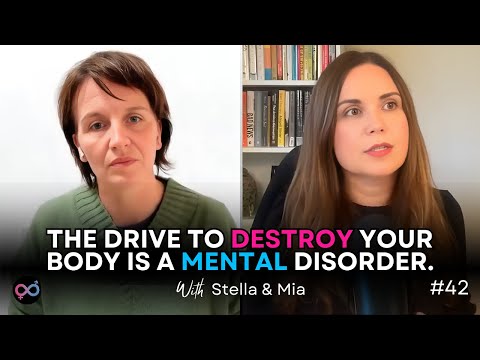
Rethinking Youth Gender Medicine with Dr Louise Irvine
18 June 2026
With Dr Louise Irvine
youth-gender-medicine
Dr Louise Irvine, co-chair of the Clinical Advisory Network on Sex and Gender, joins the Beyond Gender hosts to examine how UK youth gender medicine lost its empirical footing. The conversation covers institutional capture of the NHS, the WellBN clinic investigation, the problem of circular research design in paediatric gender care, and a forthcoming professional conference in London attempting to rebuild the field on honest clinical ground.
Dr Louise Irvine brings a clinician's perspective to questions that have long been shaped more by administrators and advocates than by rigorous science. As a general practitioner, GP trainer, and co-chair of the Clinical Advisory Network on Sex and Gender, she has spent years watching a field that was supposed to follow evidence drift steadily toward ideology. Her conversation with the Beyond Gender hosts covers the state of youth gender medicine in the UK, how the profession arrived at this point, and what a credible course-correction might require. The episode centres partly on CAN-SG's upcoming London conference on rethinking youth gender medicine, which brings together clinicians, researchers, and ethicists to examine how paediatric gender care became so compromised. The conference is significant not merely as a gathering of critics but as a formal professional effort to reopen empirical questions that were closed prematurely. The fact that those questions are now being posed openly, in a serious clinical context, reflects a genuine shift in institutional mood. Much of the conversation concerns how institutions like the NHS became captured by a particular ideological framework. The process was not abrupt. It accumulated through hiring decisions, training cultures, the marginalisation of dissenting clinicians, and an environment in which affirmation was assumed to be the only compassionate response available. The result was a clinical context in which robust questioning became professionally hazardous, and in which adolescents with complex underlying difficulties were directed onto pathways carrying serious and often irreversible consequences. The WellBN clinic investigation receives sustained attention as a concrete case study of what institutional capture looks like in practice. Irvine recaps what the investigation found and what it reveals about the gap between stated clinical standards and what actually happened to real patients. These are not abstract governance failures. They are the downstream consequences of a field that stopped asking hard questions because doing so carried too high a professional cost. The concept of tooth fairy science, drawn from the work of Helen Joyce, runs through the discussion of research methodology in this area. The phrase names a particular kind of intellectual failure: study designs whose premise already assumes the outcome they are supposed to test, generating data that loops back to confirm what was never seriously in doubt. Understanding how this circular reasoning became embedded in mainstream paediatric practice is essential to diagnosing the wider epistemic collapse the episode examines. At its core, the episode asks whether institutions can correct themselves or whether correction requires sustained external force. The emerging answer is that it requires both. The CAN-SG conference represents one serious attempt at the former: a structured clinical effort to rebuild on honest empirical ground, and to give practitioners the language and confidence to offer their patients something more rigorous than ideology dressed as medicine.